
Oh My, Kale

Today we’re doing a kale salad. Before you screech, “NOT ANOTHER GODDAMN KALE RECIPE!!!”, please remember: This is a blog for easy ways to be healthy.

And kale helps with that.

I won’t bore you with details. But one thing: Kale isn’t a miracle food (many leafy greens are just as good), but it’s got some interesting texture that makes it somewhat unique. Plus, kale is in the cabbage family, along with broccoli, cabbage, and brussels sprouts, so it has some cancer-fighting compounds in it. Hey, maybe kale is pretty great after all!

You will need:

1 bunch curly (not lacinato) kale

1 orange

1 handful of pecans

1 handful of dried cranberries (sweetened)

1 tablespoon of olive oil

1 tablespoon of dijon mustard

1 tablespoon of vinegar

fresh chevre (goat cheese) (You could also use feta, or even blue cheese. I’m not your mom. Whatever.)
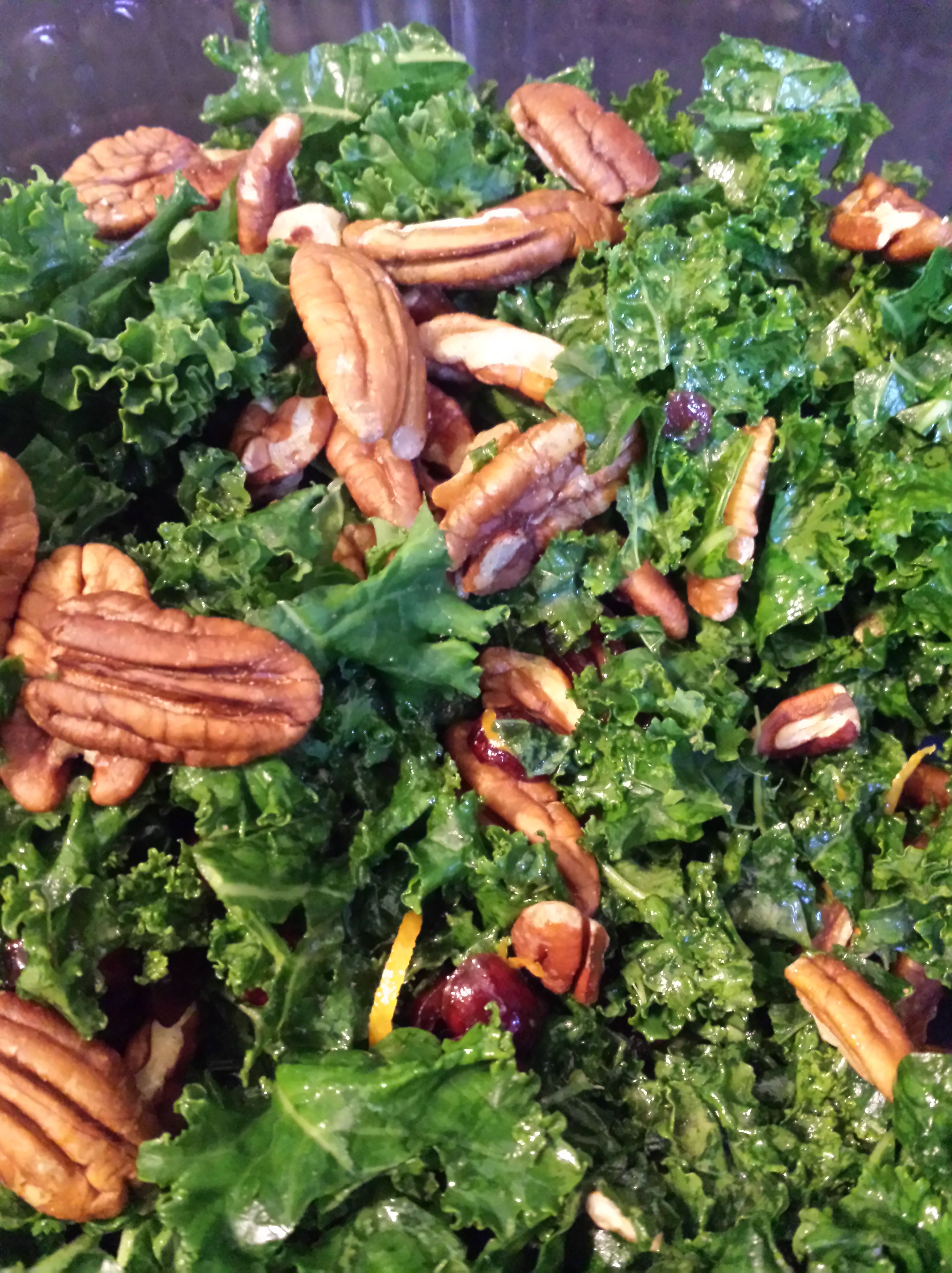
20151111_113729

STEP ONE: CHOP KALE

I like to remove the middle rib by slicing the leaf off (leaving a kale leaf with a shallow “v” where the rib was), and then slice the leaves into 1/4″ ribbons. But you can cut, tear, or otherwise disassemble the kale however you desire. Just remember that if the pieces are too big (or too tiny) it can be tough to eat.

STEP TWO: MASSAGE THE KALE

This sounds weird. Heck, it *is* weird. But it works. Why? Massaging the kale breaks down the tough cellulose fibers that make kale “chewy” without having to cook it.  Here’s how you do it: Put the chopped kale into a big bowl. With VERY CLEAN HANDS, reach into the bowl, grab a two big handfuls, and *squeeze*. Maybe even rub the kale between your palms a little. Do this until the kale starts to look almost like you’ve cooked it. Experiment with how much or how little you like to moosh your kale.

STEP THREE: MAKE YOUR DRESSING

The easiest way to make this dressing is to save an old glass jar with a lid, or, if you have one around, use a pint canning jar.

First, prep your orange. If you’re fancy, zest the orange and add the zest to the jar. A lot or a little-depends on how much orange flavor you like. Personally, I love citrus, so I use almost the whole orange worth. Then, slice the orange in half and juice it into the jar, making sure you don’t get any seeds in there. Add your olive oil, vinegar, and dijon mustard. (Pro tip: The mustard helps the dressing to emulsify, so don’t forget that.) Put the lid on the jar and shake vigorously until the dressing is well-blended.

STEP THREE: ADD THE GOODIES

Add the salad dressing to the kale and mix until it’s well-covered. Then add the nuts, cranberries, and mix again.

STEP FOUR: CHEESE

Right before serving, crumble up a bit of the goat cheese and add to the top. Yummy!

Greens in a Blender

Everybody knows you have to eat your greens, but you can get really tired of salad. So here’s an option that’s stupidly easy and pretty tasty.

I’m gonna call this a Level Two recipe just because you need a blender, but it’s falling-off-a-log easy, and if you have a blender you can make it.

I’ll also give a shout-out to Costco, because this recipe is basically 100% Costco.

Here’s the deal: You’re gonna put a crap-ton of fruits and veggies in a blender with some juice and some water, and you’re going to make a gallon of this weird, green, tasty stuff, and then you’re going to drink it. That’s it. It’s loaded with vitamin A and C, potassium, fiber, phytochemicals (those are good), and it’s pretty tasty. The only “bad” is that it doesn’t have much protein or fat, and if you went overboard and drank half the batch that would be kind of a lot of sugar. But, hey, if you’re going to consume too much sugar, it’s probably better to do it in the form of a green drink than, say, a pint of Haagen-Daas.

INGREDIENTS:

1 1/2 lb mixed dark leafy greens (I used the Costco bag of raw Earthbound Farm “Power Greens” which is kale, spinach, and chard)

1 banana

4 kiwi fruit, peeled (I prefer the gold ones, but whatever floats your boat)

1 cup frozen cherries

1 cup pomegranate juice (more if needed)

1 cup water (more if needed)

Blend in batches, pour into a 1 gallon container with a lid (like a clean milk jug), and shake well before serving. That’s it. I usually have to do it in about 3 batches, then I pour it all into the jug and shake it really, really well. You can add more or less water depending on how thick you want it.

But that’s it. You now have green smoothies for the next few days, and as long as you drink a nice big glass daily, you’ll be well on your way to your 5 servings of fruits and veggies!

Why Popular Media Gets Nutrition Wrong

There was a much-ballyhooed study published in Nature (arguably THE science journal, with a huge amount of importance) on mice fed a “paleo” diet (A low-carbohydrate high-fat diet increases weight gain and does not improve glucose tolerance, insulin secretion or β-cell mass in NZO mice). And guess what? This study meant a flurry of blog posts and articles. Many, like this one on the popular site Mashable say that this study means that the Paleo Diet is “bad for you”. Unfortunately, that’s…kinda (really) wrong. That’s not what the study says. Like many (if not most) popular science articles on nutrition, it oversimplifies the study and it overgeneralizes the results.

Fatmouse

Image courtesy Wikimedia.  Public Domain, https://commons.wikimedia.org/w/index.php?curid=1777620

For starters, it was a study on mice. While animal research provides a great deal of vital information, there’s a very good reason that you can’t release a drug after only animal trials. “Are you man or mouse?” isn’t just a rhetorical question here. While animal trials can be compelling and provide a good foundation for further exploration, we’re not mice. So, right there you can say that while the study provides interesting evidence, you can’t conclusively say that it means that the “paleo diet is bad”. And a lot of paleo blogs are attacking the study, as you’d expect. While I’m not a proponent of the paleo diet, I do agree with some of the criticism of the study, e.g. the type of fats and protein used. (I won’t bore you with the Science Wonk about why I agree with that criticism, but let’s just say that I’d like to see the mouse study done with different sources for fats, carbs, and protein.)

But, really, both the blog post and the article on Mashable have lots of flaws. The Mashable article overgeneralizes. The blog post combines some valid (in my eyes) criticism with “anecdata”. In other words, both of them aren’t great, and both of them seem to have their own biases, implicit or otherwise.

The simple fact is, human nutrition is complicated, people are different than mice, and it’s really, really, really hard to write a popular science article about nutrition without oversimplifying to the point of inaccuracy.

The take home message? Never rely on a single article or blog post as the final word in nutrition. And that includes this blog!


Ten minute walk more beneficial for energy than a candy bar

This is just a short abstract (the whole article is behind a paywall), but it’s worth checking out. Basically, some researchers found that people reported more energy after a short walk than people that just ate a candy bar. A ten minute walk is pretty moderate, and easily incorporated into almost anyone’s day. Another easy thing to do!,